WHY THIS CLASSIC
为什么入选
作品以固定空间容纳众多人物,用短促对话呈现社会变化。它适合学习群像戏、潜台词和“以小见大”的写作方法。
A fixed setting holds a large ensemble, while brief exchanges register social change. The play is ideal for studying ensemble drama, subtext, and the use of a small space to reveal a large world.
READING CONTEXT
阅读坐标
《茶馆》由老舍创作,北京人民艺术剧院于1958年首演。三幕跨越不同历史时期,茶馆老板王利发与各色茶客的命运共同构成时代切片。
Written by Lao She and first staged by Beijing People’s Art Theatre in 1958, the three-act play crosses different historical periods. The fate of proprietor Wang Lifa and his patrons forms a social cross-section.
BILINGUAL CLOSE READING
一间茶馆,一座城市
One teahouse, one city
编辑说明
以下内容为 Hanyu365 原创教学场景改写,仅保留作品的公共背景、人物功能与主题线索;不复制剧本台词,不替代正版剧本或演出。
This original Hanyu365 teaching scene retains only public background, character functions, and thematic threads. It reproduces no script dialogue and does not replace an authorized edition or performance.
中文 · 01
开门时先看水壶
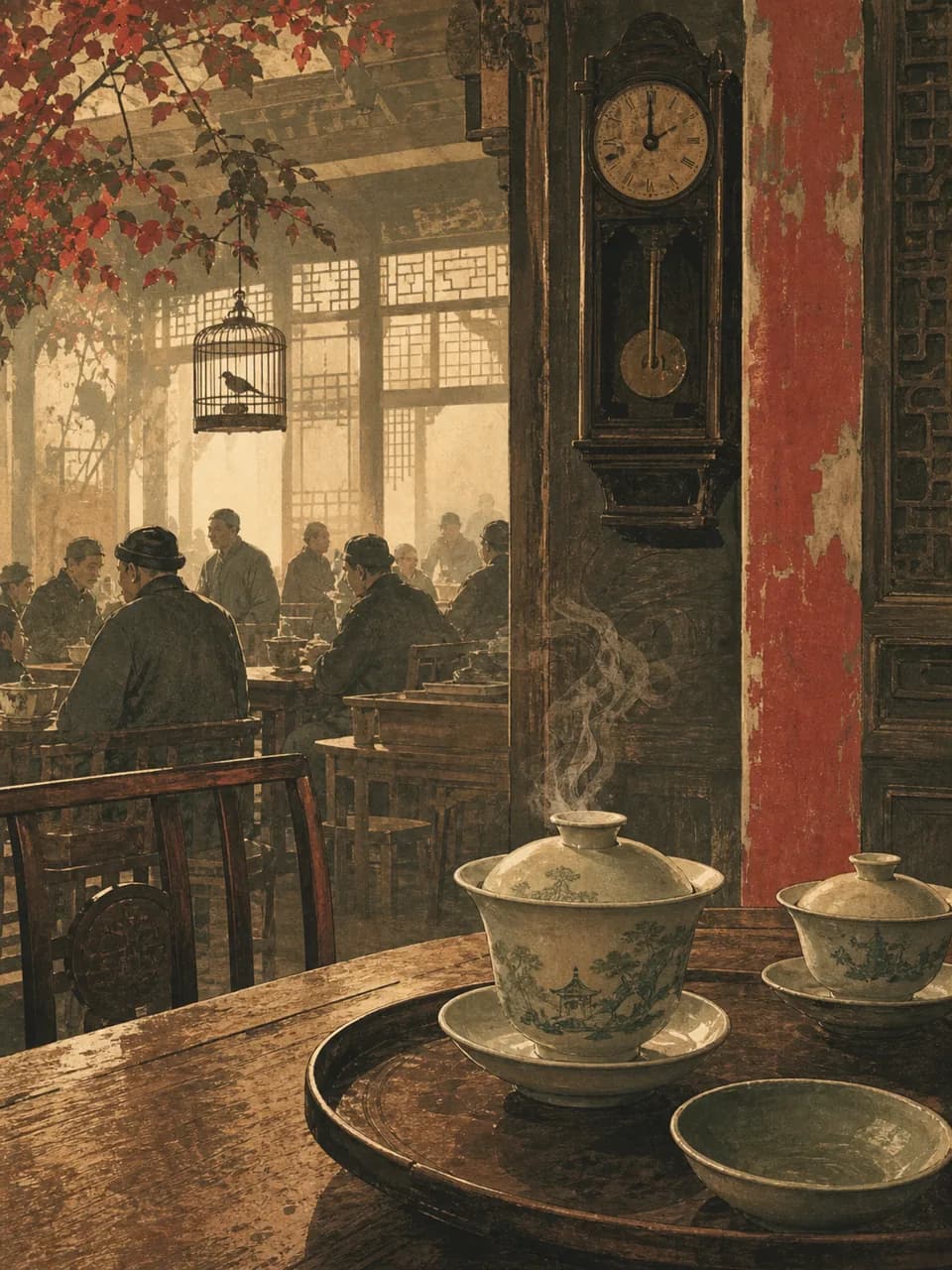
清晨开门,掌柜先检查水壶、桌面和零钱,又朝街口看了一眼。茶叶涨价、客人减少、消息一天比一天复杂,可店门仍要按时打开。这个教学改写没有让人物长篇诉苦,而是把焦虑放进一连串熟练动作:擦桌子比平日更用力,算账时多停一会儿,听见脚步便立刻换上招呼客人的神情。做生意的人必须维持体面,让每位进门者先看见热茶和秩序。越是平静的日常,越能衬出他正在独自承担的不安,也让茶馆成为时代压力落到普通人生活里的第一现场。
写法提示:用道具和动作代替直接说明,让人物的压力进入舞台。
English · 01
At opening time, check the kettle
At opening time, the proprietor checks the kettle, the tabletops, and the small change, then looks once toward the end of the street. Tea has become more expensive, customers are fewer, and the news grows more complicated each day, yet the doors must still open on time. This original teaching adaptation does not give him a long speech of complaint. Instead, anxiety is placed within familiar actions: he wipes a table harder than usual, pauses over the accounts, and changes his expression as soon as footsteps approach. A shopkeeper must preserve appearances so that each guest first encounters hot tea and order rather than the owner’s trouble. The calmer the routine seems, the more clearly it reveals the worry carried alone. The teahouse becomes the first place where the pressure of an era enters ordinary daily life.
Craft note: Props and actions carry pressure onto the stage without direct explanation.
中文 · 02
不同的人坐在同一间屋里
靠窗的客人高声谈论新鲜事,角落里的人压低声音交换担忧,跑堂的端着茶碗在桌缝间来回,还要分辨哪些话适合接、哪些话最好装作没有听见。同一间屋里,不同身份的人短暂共享空间,却未必真正理解彼此。有人关心生计,有人谈论规矩,有人只想打听风向。每一句话看似只属于个人,合在一起却像一张不断变化的城市地图。茶馆的舞台价值正在这里:它不必把时代写成抽象说明,只要让各种口音、利益和沉默相互碰撞,观众就能从一室喧闹中听见社会结构。
写法提示:群像戏不依赖唯一主角,而让位置、语气和话题共同组织叙事。
English · 02
Different people share one room
Customers by the window discuss the latest news loudly, while people in a corner exchange worries in lowered voices. A waiter carries bowls between narrow spaces and must decide which remarks invite a response and which are safer to pretend he never heard. People of different status briefly share one room without necessarily understanding one another. One is concerned with making a living, another talks about rules, and someone else merely wants to learn which way events are turning. Each statement seems private, yet together they form a changing map of the city. This is the dramatic value of the teahouse. The stage does not need to explain an era in abstract terms. By allowing accents, interests, jokes, and silences to collide in a single room, it lets an audience hear the shape of society within ordinary noise.
Craft note: Ensemble drama organizes narrative through position, tone, and topic rather than a single hero.
中文 · 03
空着的座位也在说话
到了傍晚,一位常来的客人始终没有出现。他过去坐惯的位置空着,旁人偶尔看一眼,却没有谁把疑问完整说出口。掌柜收拾桌面时停了停,最后把那只熟悉的茶碗放回柜里。这个教学改写用空缺代替解释:人物不在场,反而迫使观众注意他为何消失,以及周围人为何不敢追问。舞台上的空座位既属于一个普通客人,也像属于城市中越来越多被迫离开的人。茶馆仍然营业,杯盏仍有声响,但旧有关系已出现裂缝;变化不是由宣言宣布,而从再也等不到的身影中被看见。
写法提示:省略事件本身,用缺席留下更大的历史想象空间。
English · 03
An empty seat can speak
By evening, a familiar customer still has not appeared. The place where he usually sits remains empty. Others glance toward it, yet no one completes the question aloud. While clearing the table, the proprietor pauses and finally returns the familiar tea bowl to the cupboard. This original teaching adaptation uses absence instead of explanation. Because the character is not on stage, the audience is compelled to ask why he has vanished and why the people around him are afraid to inquire. The empty chair belongs to one ordinary customer, but it also seems to belong to many city residents who are being pushed out of familiar lives. The teahouse remains open and bowls continue to make their everyday sounds, yet older relationships have cracked. Historical change is not announced by a speech; it becomes visible through a figure for whom people wait in vain.
Craft note: Omitting the event itself allows absence to open a larger historical space.
中文 · 04
掌柜靠听话维持一间茶馆
掌柜的本领不只在泡茶、算账和招呼客人,还在于听懂一句话背后的分量。有人高声抱怨,只是想在熟人面前逞强;有人随口问价,真正担心的却是明天的生计;也有人把危险消息藏在玩笑里,等着看别人如何反应。他必须判断什么时候接话能缓和气氛,什么时候沉默才能保护客人和自己。这个教学改写把经营写成一种持续的社会阅读:茶馆出售的是茶,也提供短暂停留、交换消息和观察风向的空间。掌柜越能听懂众人的言外之意,观众越能看到他为何疲惫。时代不是从门外突然闯入,而是每天借客人的语气,一点点改变店里的生存规则。
写法提示:以“听言外之意”串联经营动作和时代压力,让掌柜成为观察社会的舞台支点。
English · 04
A proprietor keeps the teahouse open by listening
The proprietor’s skill lies not only in making tea, keeping accounts, and greeting customers. He must hear the weight behind a sentence. One guest complains loudly merely to display confidence before acquaintances; another casually asks about a price while actually fearing for tomorrow’s livelihood; someone else hides dangerous news inside a joke and waits to see how others respond. The proprietor decides when an answer can lower tension and when silence is the only way to protect both customer and shop. This original teaching adaptation presents business as continuous social reading. The teahouse sells tea, but it also offers a temporary place to rest, exchange information, and observe changing conditions. The better the proprietor understands what remains unsaid, the more clearly the audience sees why he is exhausted. History does not burst through the door in one moment; it changes the rules of survival gradually through the tone of daily conversation.
Craft note: Listening for what remains unsaid joins ordinary business to historical pressure and makes the proprietor the stage’s social observer.
中文 · 05
同一间屋子怎样被时间改写
茶馆最有力量的结构,不在于不断更换地点,而在于让相似的桌椅、门窗和招牌经历不同时代。观众认得这个空间,因而更容易察觉变化:过去常来的客人不见了,新人物占据旧座位,曾经可以公开谈论的话变成低语,掌柜维持体面的方式也越来越艰难。同一间屋子像一把固定的尺,测量社会关系怎样移动。时间并非只写在字幕或年份上,而写在谁能够坐下、谁必须离开、什么商品还能买得起。这个教学改写因此把空间当作历史档案。茶馆没有开口讲述全部年代,却让每一次开门都留下上一段生活被改写的痕迹。
写法提示:固定空间与变化人物形成对照,使宏观历史通过可比较的舞台细节被观众感知。
English · 05
How time rewrites the same room
The teahouse gains structural power not by constantly changing location, but by allowing familiar tables, windows, doors, and signs to pass through different periods. Because the audience recognizes the room, change becomes easier to detect. Former regulars disappear, new figures occupy old seats, subjects once discussed openly are reduced to whispers, and the proprietor finds it increasingly difficult to preserve the appearance of order. The unchanged room works like a fixed ruler measuring the movement of social relationships. Time is recorded not only by dates or captions, but by who may sit, who must leave, and which ordinary goods remain affordable. This original teaching adaptation therefore treats space as a historical archive. The teahouse never narrates an entire era directly, yet each opening of its doors preserves traces of a previous life being rewritten.
Craft note: A stable room contrasted with changing occupants allows broad history to be felt through comparable stage details.
LANGUAGE FOCUS
关键词语
掌柜
zhǎng guì
旧时商店或客店的负责人。
the proprietor or manager of a traditional shop
掌柜既要招呼客人,也要维持店里的秩序。
The proprietor welcomes guests while maintaining order in the shop.
三教九流
sān jiào jiǔ liú
泛指社会上各种行业、身份的人。
people from many walks of life
茶馆让三教九流在同一空间相遇。
The teahouse brings many walks of life into one room.
潜台词
qián tái cí
台词表面之外没有直接说出的意思。
meaning implied beneath spoken dialogue
一句客套话背后,可能藏着人物的潜台词。
A polite phrase may conceal a character’s subtext.
群像
qún xiàng
对一群人物的整体刻画。
an ensemble portrait
多位茶客共同构成城市群像。
Many patrons together create an ensemble portrait of the city.
DISCUSSION
读后思考
- 01
为什么茶馆比官署或战场更适合观察普通人的时代变化?
Why might a teahouse reveal ordinary people’s historical experience better than an office or battlefield?
- 02
选择一件舞台道具,说明它怎样表现人物处境。
Choose one stage prop and explain how it reveals a character’s situation.
- 03
群像戏中没有唯一主角,会给观众带来什么阅读难度与收获?
What challenges and rewards arise when an ensemble drama has no single dominant hero?
SOURCES & EDITIONS
资料与版本说明
- 1. 北京人民艺术剧院
Beijing People’s Art Theatre · 核对 2026-07-24
- 2. 老舍纪念馆:逛丹柿小院,品北平之秋
北京市文化和旅游局 · 核对 2026-07-24
封面为 Hanyu365 原创生成式插画;页面文字由本站编辑性编写。 外部资料用于核对作品背景与版本线索,不代表外部机构为本站内容背书。