WHY THIS CLASSIC
为什么入选
篇幅适中、线索清楚,景物描写与社会想象彼此推进。它既适合训练文言叙事,也能引导学生讨论“理想生活”与现实秩序。
Its compact plot, clear clues, and blend of landscape with social imagination make it ideal for studying classical narration and debating the meaning of an ideal life.
READING CONTEXT
阅读坐标
陶渊明生活在政局动荡的东晋。文章没有直接提出制度方案,而是借一次“偶然进入、无法重返”的旅程,让安定、劳动与邻里关系成为可感的生活图景。
Tao Yuanming lived during the unsettled Eastern Jin. Rather than propose a political program, the essay makes stability, work, and neighborly life tangible through a journey that happens by chance and cannot be repeated.
SOURCE TEXT
沿溪而行
Following the stream
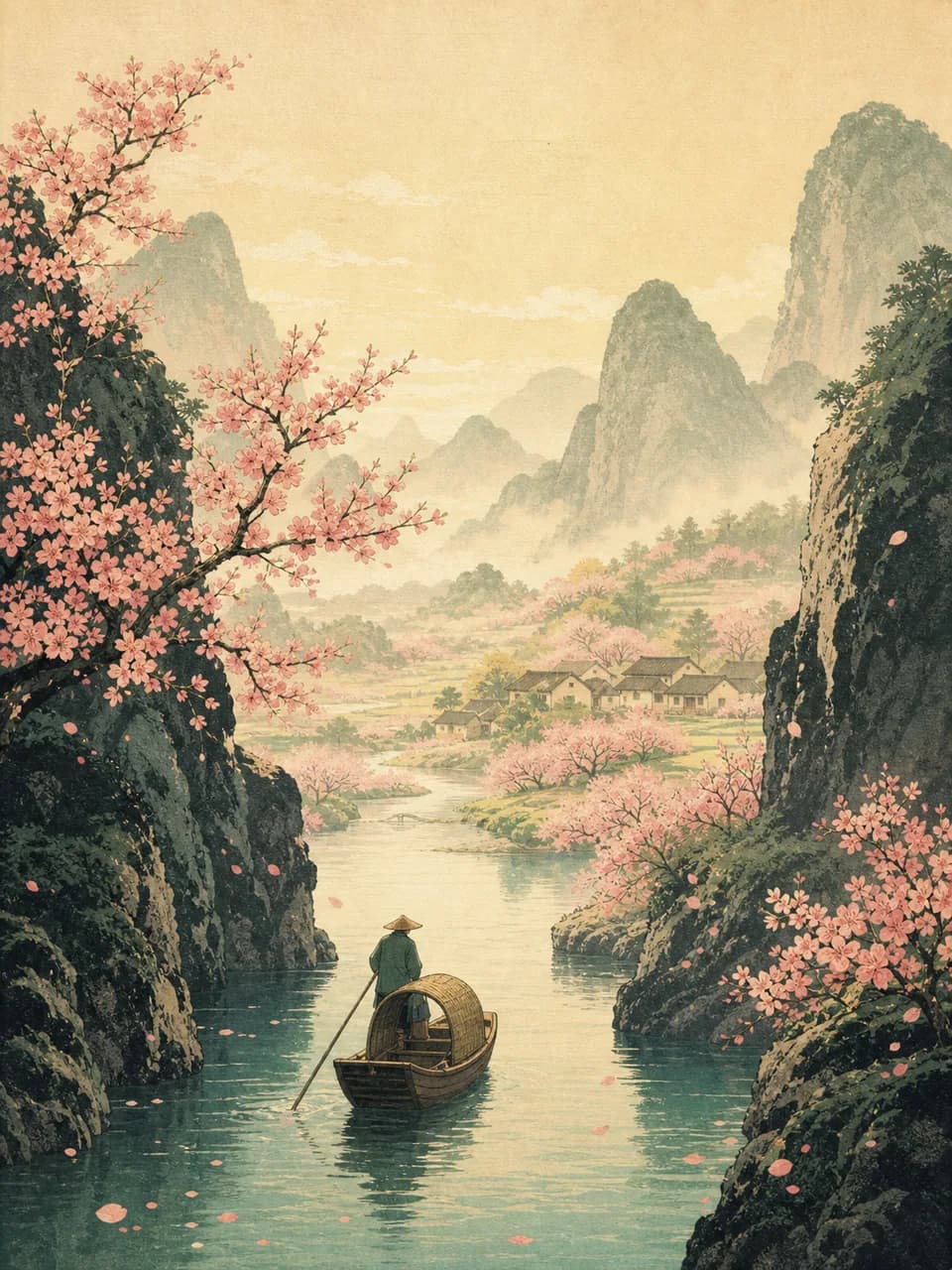
晋太元中,武陵人捕鱼为业。缘溪行,忘路之远近。忽逢桃花林,夹岸数百步,中无杂树,芳草鲜美,落英缤纷。
During the Taiyuan era of Jin, a man of Wuling made his living by fishing. Following a stream, he lost track of the distance. Suddenly he came upon peach trees lining both banks, with fresh grass and petals drifting everywhere.
BILINGUAL CLOSE READING
沿溪而行
Following the stream
编辑说明
上方为公共领域原典短句;下方中英文导读由 Hanyu365 依据原意原创编写,不替代校勘本全文。
The short source passage above is in the public domain. The bilingual study text below is an original Hanyu365 adaptation and does not replace a critical edition.
中文 · 01
忘记路程
渔人沿着溪水前行,本来只是为了谋生。他没有寻找奇境的计划,也没有一张通往别处的地图,只在水流和山势之间不断向前。等到两岸渐渐陌生,他才发现自己已经忘了路程的远近。“忘”不是粗心,而像一道轻轻合上的门:日常生活仍在身后,却失去了可以精确返回的坐标。文章由此把一次普通劳动写成偶然的越界,让桃花源不是被征服的目的地,而是人在放下既定方向之后才可能遇见的世界。
写法提示:“忘”让现实与奇境之间没有明显门槛,转折显得自然。
English · 01
Losing count of distance
The fisherman follows the stream because fishing is his ordinary work. He has no plan to discover a hidden country and no map pointing beyond the valley; he simply moves with the water and the shape of the mountains. Only when both banks begin to look unfamiliar does he realize that he has lost count of the distance. His forgetting is more than carelessness. It acts like a door closing softly behind him: everyday life still exists, but its exact coordinates can no longer guide him back. In this way, a routine journey becomes an accidental crossing. The Peach Blossom Spring is not a destination he conquers, but a world encountered only after fixed directions have fallen away.
Craft note: The act of forgetting removes any hard boundary between everyday reality and wonder.
中文 · 02
忽逢桃林
桃树夹着两岸延伸,别的树木渐渐消失,鲜亮的花瓣落在水面,也落进渔人的视线。作者没有立刻写村庄和人物,而是先让色彩、香气与整齐的林木改变旅途的气氛。景物越纯净、越有秩序,读者越能感到这里不同寻常;但这种异常并不令人恐惧,反而以美吸引人继续前行。桃林因此既是自然风景,也是叙事中的门廊:它把尘世的混乱留在外面,又用一条看得见的道路,引导渔人靠近尚未显露的理想生活。
写法提示:由“杂”到“纯”的视觉变化,制造了桃源入口的秩序感。
English · 02
The sudden grove
Peach trees extend along both banks until other kinds of trees disappear. Bright petals fall onto the water and into the fisherman’s field of vision. The writer does not reveal the village or its people at once. Instead, colour, fragrance, and the ordered grove first change the atmosphere of the journey. The purer and more deliberate the landscape appears, the more clearly the reader senses that this place is unusual. Yet the strangeness does not produce fear; beauty invites the fisherman to continue. The grove therefore serves as both scenery and an architectural passage within the story. It leaves the disorder of the familiar world outside while providing a visible path toward a form of ideal life that has not yet been disclosed.
Craft note: The shift from visual variety to purity gives the entrance a sense of deliberate order.
中文 · 03
不可复制的入口
离开桃花源后,渔人一路做下标记,希望把偶然的发现变成可以重复的路线。可是当官府派人同行,山川仿佛恢复了沉默,先前清楚的入口再也找不到。这个结尾没有简单宣布桃源真假,而是改变了问题的方向:当宁静生活被画进地图、纳入权力和占有的计划,它是否还可能保持原来的样子?无法重返使桃源从地理地点变成价值尺度。读者不能沿着渔人的标记抵达那里,却可以反过来审视现实中缺少了哪些安定、尊重与互助。
写法提示:结尾把地理悬念转化为价值追问,使故事有了余味。
English · 03
An entrance that cannot be mapped
After leaving the Peach Blossom Spring, the fisherman marks the route so that a chance discovery can become a repeatable journey. Yet when officials accompany him, the mountains and streams seem to fall silent, and the once-visible entrance cannot be found. The ending does not simply declare whether the village is real or imaginary. Instead, it changes the direction of the question: once a peaceful way of life is placed on a map and drawn into plans of authority and possession, can it remain what it was? The failed return transforms the village from a geographical site into a measure of values. Readers cannot reach it by following the fisherman’s signs, but they can use it to ask what stability, dignity, and mutual care are missing from the world they already inhabit.
Craft note: The ending turns a geographical mystery into a question of values.
中文 · 04
村庄怎样让理想变得可信
进入洞口之后,渔人看到的并不是金银宫殿,而是平整的田地、清楚的道路、安静的房屋,以及愿意往来的邻里。老人和孩子都能从容生活,说明桃源的美不只来自风景,还来自一种不必时时防备的社会关系。村民询问外界变迁,又共同招待陌生人,使“与世隔绝”并不等于冷漠封闭。他们有劳动,也有记忆;有自己的秩序,却不靠炫耀权力来维持。作者用一系列普通生活细节,把抽象的理想写成可以想象的一日三餐。读者因此会发现,真正稀有的并非奇花异草,而是普通人能够稳定劳作、安心交谈,并相信明天仍可照常到来的生活。
写法提示:用田地、道路和往来等日常细节承载理想,比直接赞美更具体,也更有说服力。
English · 04
How the village makes an ideal believable
After passing through the narrow opening, the fisherman does not discover palaces filled with gold. He sees level fields, clear paths, quiet houses, and neighbours who can visit one another without fear. Elderly people and children live at ease, showing that the village’s beauty comes not only from landscape but from social relationships in which constant defence is unnecessary. The residents ask about changes in the outside world and share food with a stranger, so isolation does not mean emotional coldness. They work and remember; they possess order without displaying power as the source of that order. Through ordinary details, the writer turns an abstract ideal into a daily life readers can imagine meal by meal. The truly rare feature is therefore not a grove of miraculous flowers. It is a world in which ordinary people can work steadily, speak without anxiety, and trust that tomorrow’s routines will still be possible.
Craft note: Fields, paths, and neighbourly exchange make the ideal concrete without relying on direct praise.
中文 · 05
桃源留下的现实问题
故事结束以后,桃花源并没有因为无法再访而失去意义。恰恰相反,它把问题留给仍在现实中的读者:什么样的生活会让人渴望躲进深山?如果和平、劳动尊严与邻里信任只能存在于传说,现实秩序需要改变什么?阅读时既不能把桃源当成一张可以照搬的制度蓝图,也不必把它轻轻归为逃避。文学想象的重要作用,是先让缺少的东西获得形状,使人能够比较“已经如此”与“还可如何”。桃源的入口最后消失,价值判断却被带了出来。每一代读者都可以重新回答,自己所处的社会距离那份安定有多远,又愿意从哪些具体关系开始缩短距离。
写法提示:把奇遇结尾转向当代读者,让古代寓言从答案变成可以反复讨论的问题。
English · 05
The question the hidden village leaves behind
The Peach Blossom Spring does not lose its meaning merely because nobody can visit it again. On the contrary, it leaves a question with readers who remain in the ordinary world: what conditions make people long to hide beyond the mountains? If peace, dignity in labour, and trust between neighbours can exist only in legend, what must change within real social life? The hidden village should not be treated as a complete political plan ready to copy, but neither should it be dismissed as simple escape. Literary imagination gives shape to what is missing, allowing people to compare what already exists with what might still become possible. The entrance disappears, yet the standard of judgment returns with the reader. Every generation can ask again how far its own society stands from such stability and which concrete relationships it is willing to improve first.
Craft note: Turning the ending toward present readers transforms the ancient tale from an answer into a renewable question.
LANGUAGE FOCUS
关键词语
缘溪
yuán xī
沿着溪流。
to follow a stream
渔人缘溪而行,逐渐离开熟悉的水域。
Following the stream, the fisherman gradually leaves familiar waters.
落英缤纷
luò yīng bīn fēn
落花繁多而纷飞。
fallen petals drifting in profusion
落英缤纷不是静止的布景,而是引路的动态画面。
The drifting petals are not a static backdrop; they lead the eye forward.
豁然开朗
huò rán kāi lǎng
由狭窄昏暗突然变得开阔明亮。
to open suddenly into brightness and space
穿过山口,眼前豁然开朗。
After the narrow passage, the view suddenly opens into light.
问津
wèn jīn
询问渡口;后引申为探求门径。
to seek a crossing; by extension, to seek a way in
此后无人问津,桃源也成为想象中的坐标。
No one sought the crossing again, and the Peach Blossom Spring became an imagined coordinate.
DISCUSSION
读后思考
- 01
桃花源最吸引人的,是自然环境、社会关系,还是“与外界隔绝”?说明理由。
What is most compelling about the Peach Blossom Spring: its landscape, its social relations, or its isolation? Explain.
- 02
如果渔人没有做标记,文章的结尾会失去什么?
What would the ending lose if the fisherman had never marked the route?
- 03
现实中的理想生活是否也需要边界?请用一个当代例子讨论。
Does an ideal life in the real world also require boundaries? Discuss with a contemporary example.
SOURCES & EDITIONS
资料与版本说明
- 1. 桃花源記
Chinese Text Project · 核对 2026-07-24
- 2. Primary Source Document: The Peach Blossom Spring
Columbia University, Asia for Educators · 核对 2026-07-24
封面为 Hanyu365 原创生成式插画;页面文字由本站编辑性编写。 外部资料用于核对作品背景与版本线索,不代表外部机构为本站内容背书。